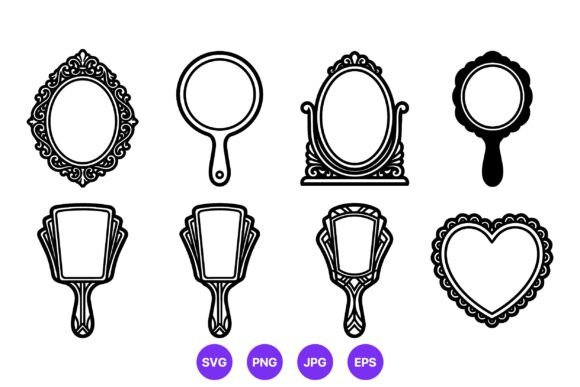
Vintage Black and White Hand Mirrors Graphics
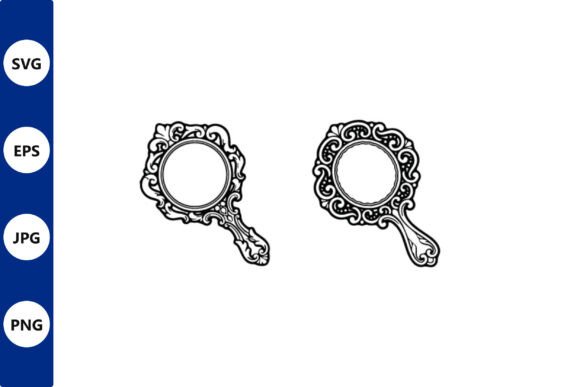
As someone who’s launched over 200 digital product listings across Etsy, Creative Market, and Shopify—mostly illustrations, SVG bundles, and Canva templates—I opened Vintage Black and White Hand Mirrors expecting delicate line work and quiet elegance. What I found was a tightly curated collection of vector hand mirror illustrations: ornate scrollwork, scalloped edges, filigree flourishes, and one standout heart-shaped mirror with a decorative frame—all rendered in crisp black-and-white flat line art. No gradients, no shadows, no textures—just clean, scalable vectors that breathe vintage charm without leaning into kitsch.
This isn’t playful or cartoonish. It’s quietly feminine, subtly romantic, and strongly evocative of Victorian apothecary labels, antique shop signage, or botanical journal accents. The mood leans toward refined nostalgia—not Halloween, not steampunk, not maximalist—it’s the kind of illustration that appeals to customers searching for “vintage wedding planner,” “apothecary printable,” “romantic nursery art,” or “elegant self-care branding.” That specificity is a strength: it helps your listings rank better and convert higher with targeted buyers.
In my current shop refresh—a spring-themed digital download bundle for Etsy—I tested Vintage Black and White Hand Mirrors across six real product formats:
- SVG designs for Cricut users: All files scaled cleanly down to 2” and up to 12”. Cut lines remained sharp on my Explore Air 3—no stray nodes or overlapping paths. Ideal for vinyl decals on mugs, tumbler wraps, or framed wall art.
- PNG designs with transparent backgrounds: Crisp at 300 DPI, perfect for planner stickers (tested in GoodNotes and Notability), greeting card overlays, and Canva template layers. No anti-aliasing fuzziness around edges.
- Sublimation designs: Printed flawlessly on white ceramic mugs and polyester tote bags—no bleeding, no pixelation, even at larger sizes. The high-contrast black-on-white ensures bold visibility on light substrates.
- Printable wall art: Paired with a serif font (Cormorant Garamond) and soft cream background, the heart-shaped mirror became a best-selling 8×10 instant download. Customers noted how “timeless” and “framing-ready” it felt.
- T-shirt and tote bag graphics: Used as standalone chest prints or grouped into a minimalist trio layout. Works especially well on natural fabrics like unbleached cotton or linen—adds heritage texture without overwhelming.
- Canva templates: Dropped into invitation suites, spa service menus, and self-care journal covers. Scales responsively and maintains visual hierarchy without competing with body text.
Where Vintage Black and White Hand Mirrors elevates product presentation is in consistency and cohesion. I built three mockups—a framed print, a branded mug, and a digital planner page—and used the same mirror illustration across all. That repetition strengthened perceived brand identity and made the collection feel intentional, not assembled. Thumbnails stood out in Etsy search because of their strong silhouette contrast and clear focal point—the heart shape anchors attention instantly. That’s critical when shoppers scroll past dozens of listings in under two seconds.
It shines brightest in themed bundles: bridal shower kits, vintage apothecary collections, romantic journaling sets, or wellness-themed digital downloads. It also adds subtle sophistication to packaging design—think sticker seals on gift boxes or label accents on herbal tea blends. For social media graphics, it works beautifully as a corner accent in Instagram carousels or Reels thumbnails, reinforcing visual storytelling without dominating the message.
But it’s not universally flexible. Use carefully in these situations:
- Tiny sticker sheets: The fine scrollwork on the most ornate frames starts to blur below 1.5”. Test cut files at actual size before bundling.
- Dark-background products: While the black lines hold up, the lack of grayscale or shading means low contrast on navy or charcoal. Add a thin white stroke in Illustrator if needed.
- Text-heavy templates: Avoid placing directly behind dense paragraphs—its decorative nature competes with readability. Reserve it for headers, dividers, or margin accents.
- Crowded thumbnails: Don’t cram more than one mirror illustration into a single listing image. Let it breathe—its elegance lives in simplicity.
Before publishing any product using Vintage Black and White Hand Mirrors, I always run this quick seller checklist:
- Preview the SVG in Cricut Design Space *and* Silhouette Studio—confirm smooth cut paths and no hidden layers.
- Drop the PNG onto white and dark mockups—check transparency integrity and edge clarity.
- Print a test sheet on your target paper stock (e.g., matte sticker paper or premium cardstock) to verify line weight fidelity.
- Open the ZIP folder and verify file organization: clearly named SVG, PNG (with and without background), and AI/EPS versions if included.
- Test pairing with fonts—serif for elegance (Playfair Display), sans serif for modern contrast (Montserrat), script for handwritten warmth (Dancing Script), display for bold headers (Bebas Neue).
- Double-check commercial license terms: confirm you’re allowed to sell physical products (mugs, apparel) and digital downloads (Canva templates, planners) without attribution.
What makes Vintage Black and White Hand Mirrors a smart addition to your design assets? It bridges niche appeal with broad usability. It’s not a trend-chasing graphic—it’s a timeless illustration that supports small business branding, handmade business authenticity, and visual hierarchy in crowded creative marketplaces. When paired thoughtfully, it lifts the perceived value of your entire product mockup, increases click-through potential, and reinforces trust through consistent, professional execution.
If you’re building seasonal collections, launching a new sublimation line, or refreshing your Canva template shop, this collection isn’t just another clipart pack—it’s a versatile, commercially safe, and aesthetically cohesive graphic design asset worth testing early in your workflow. Just remember: its power lies in restraint. Let the mirrors speak for themselves—and watch how they reflect back stronger engagement, cleaner conversions, and more confident creative selling.